7 Best Mobile Mining Units for Global Buyers
Choosing the right Mobile Mining Unit requires more than comparing capacity, price, and transport dimensions. Global buyers must examine the complete operating picture. That includes ore type, expected throughput, power availability, water access, dust control, maintenance support, and local certification requirements. A compact unit may fit neatly inside a container, yet struggle on uneven ground or in extreme heat. Another model may offer impressive processing speed but require specialized technicians and costly spare parts. Small details matter.
Robert Friedland, founder of Ivanhoe Mines, has said, “The green energy revolution is built on mining.” His observation adds context to this guide. Modern mobile systems can help reduce unnecessary hauling, shorten site preparation, and support more flexible operations. However, they are not automatically cleaner or more efficient. Fuel consumption, emissions, noise, water use, and end-of-life recycling still deserve careful review. Sometimes, the smaller machine is not the better choice.
This selection of seven leading units compares practical strengths for international buyers. We consider crushing, screening, conveying, drilling, and modular processing applications. We also assess mobility, installation time, operator safety, remote monitoring, and after-sales support. These factors often decide whether equipment performs reliably beyond the showroom.
Expect trade-offs. No single Mobile Mining Unit suits every mine, climate, or budget. A machine that performs well in a dry open pit may disappoint in a wet, remote location. Buyers should verify performance data, warranty terms, spare-parts availability, and compliance documents directly with suppliers. Careful questions prevent expensive surprises. That step is easy to overlook.
What Defines a Mobile Mining Unit for Global Buyers
7 Best Mobile Mining Units for Global Buyers
What Defines a Mobile Mining Unit for Global Buyers
A mobile mining unit is more than equipment mounted on wheels. It should combine transportability, processing capacity, power control, and site safety in one practical system. Global buyers usually assess footprint, setup time, fuel use, maintenance access, and climate tolerance. A useful unit can move between deposits without requiring a complete plant rebuild.
Energy performance matters. The International Energy Agency reported that demand for lithium rose by nearly 30% in 2023. Demand for nickel, cobalt, graphite, and rare earth elements also increased. This pressure makes flexible processing important. A compact unit can support smaller deposits and reduce unnecessary infrastructure. However, mobility does not automatically mean efficiency. That assumption needs testing.
World Bank research estimates that mineral production could increase by nearly 500% by 2050 under a clean-energy scenario. Buyers should therefore examine throughput stability, dust control, water recycling, and remote diagnostics. A strong design should include enclosed transfer points, replaceable wear parts, and clear emergency controls. It should also support local training and documented inspections. I would not treat a digital dashboard as proof of reliability. Field trials still reveal problems, especially in heat, dust, freezing conditions, and uneven terrain. Certification, spare-parts availability, and regional service capacity can matter more than impressive specifications.
How to Compare the Seven Best Mobile Mining Unit Types
How to Compare the Seven Best Mobile Mining Unit Types
Comparing mobile mining units requires more than checking hourly capacity. A field inspection should examine feed size, moisture, terrain, power access, and maintenance space. Containerized crushing and screening units suit standardized sites and easier ocean transport. Skid-mounted washing units work well where water recovery is practical. Trailer-mounted gravity separation units offer flexible relocation and relatively simple operation.
Tracked crushing units handle uneven ground and short-term projects with fewer civil works. Wheel-mounted conveying and stockpiling units move quickly between material piles, but they need firm access roads.
Compact underground units fit restricted headings and reduce haulage distances. Modular flotation units provide staged processing, although chemical handling, ventilation, and water treatment require strict control. Each type has a different cost profile.
Capacity figures can mislead. Ask for test results using ore with similar hardness, clay content, and particle size. Check noise levels, dust controls, emergency stops, guarding, and inspection records. Reliable suppliers should provide drawings, spare-parts lists, operator training, and service response terms. Local electrical standards and transport limits also affect the real purchase price.
Do not ignore climate. Cold regions can stiffen lubricants, while humid sites accelerate corrosion. Solar-assisted power may reduce fuel use, but batteries still need shelter and scheduled replacement.
I have seen buyers prioritize compact design and regret weak maintenance access. That mistake is easy to repeat. A slightly slower unit may deliver better uptime, safer access, and lower lifecycle costs.
Key Performance and Efficiency Factors to Evaluate
7 Best Mobile Mining Units for Global Buyers
Key Performance and Efficiency Factors to Evaluate
Choosing among seven mobile mining units requires more than comparing advertised output. Measure useful production against electricity consumed, because a high hash rate can hide poor operating efficiency. A unit drawing 3,000 watts may perform well, but its daily energy cost can quickly change the calculation. Check the efficiency rating in joules per terahash, then confirm the result through independent testing. Laboratory figures are useful. Real sites are less tidy.
Cooling performance deserves close attention. In a hot container, rising temperatures may reduce speed, increase failures, or shorten component life. Look for airflow design, temperature controls, dust protection, and safe shutdown functions. Noise matters near homes or shared workspaces. It is easy to overlook. Transport weight, modular construction, and access to replacement parts also affect long-term value. A compact unit may be efficient, yet difficult to service without specialized tools. That weakness can create unexpected downtime.
Reliable buyers should examine uptime records, warranty terms, monitoring software, and maintenance intervals. Ask whether performance remains stable after weeks of continuous operation, not just during a short demonstration. Power quality is another concern; unstable supply can damage equipment and distort efficiency figures. I would record temperature, energy use, output, and restart events for at least several days before purchasing. This approach is slower, but more honest. Even then, estimates remain imperfect because climate, network conditions, and operator skill can shift results.
7 Best Mobile Mining Units for Global Buyers — Key Performance and Efficiency Factors to Evaluate
The chart compares representative mid-range operating values for seven mobile mining unit categories. Throughput is shown in tonnes per hour, while specific energy demand is measured in kilowatt-hours per tonne. Actual performance depends on ore hardness, feed size, moisture, recovery targets, circuit configuration, and site conditions.
Choosing the Right Mobile Mining Unit for Different Operations
7 Best Mobile Mining Units for Global Buyers
Choosing the Right Mobile Mining Unit for Different Operations
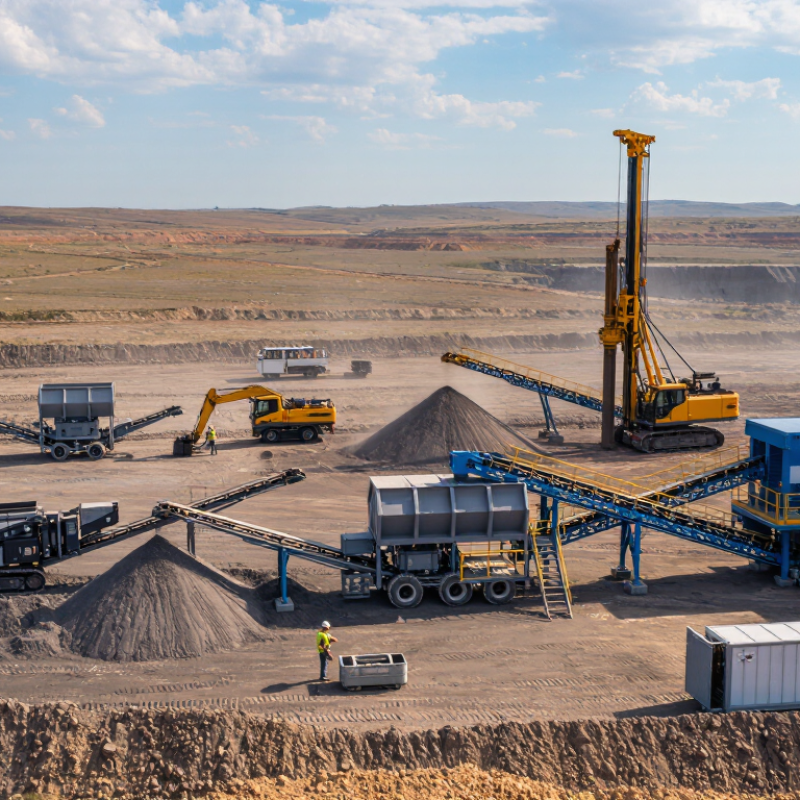
Choosing a mobile mining unit starts with the material, not the catalogue. Hard rock usually needs a mobile jaw crusher or cone crusher. Softer ore may suit an impact crusher. A mobile screening unit separates usable sizes before transport. Conveyors reduce truck movements across short, uneven distances. Stackers create controlled stockpiles beside the processing area. Sampling units support faster grade checks. Compact washing units help remove clay from selected ores.
The USGS Mineral Commodity Summaries 2025 estimates global mined copper production reached about 22 million metric tons in 2024. This scale increases pressure for flexible, high-throughput equipment. The IEA’s Global Critical Minerals Outlook 2024 expects clean-energy mineral demand to double by 2030 under stated policies. Remote projects therefore need units that travel easily and operate reliably. Check feed size, moisture, power supply, service access, and daily tonnes. Small details matter.
A short conveyor may outperform another truck. That is not always obvious. Field trials should measure fuel use, downtime, dust control, and product consistency. ISO 3082 sampling guidance can support more reliable bulk-material testing. Local climate also changes the decision. Cold sites require different hydraulic protection than wet tropical operations. A perfect unit rarely exists. I would recheck transport permits, spare-part lead times, and operator training before purchasing. The cheapest machine can become expensive when one neglected component stops production.